
VIDEO


Blog

The Kardashians have created many beauty trends, one of which is having beautiful buttocks. So, in this article, we'll talk about building great gluteus muscles so you can look as attractive as Kim, Kourtney, and Khloe. Let's begin by looking at the anatomy. The glutes are made up of three main parts.
The gluteal maximum muscles, which are the largest muscles in the body, help to maintain balance when walking and running. They allow your legs to move sideways and are also responsible for contouring the shape of the buttocks.
The gluteus medius is overlaid in part by the gluteus maximus and is located at the top of the pelvis. It is involved in leg extension, lateral flexion, and body stabilization during the movement.
Finally, below is the gluteus minimus. Both are in charge of leg induction and body stabilization, as well as shaping the thigh line.
Training for the glutes
Building your glute muscles isn't easy, particularly when you're on a tight schedule. However, by working out at least three times a week and never giving up, you will quickly reach your goal. To help you achieve your goals, we've compiled the best exercises for your gluteus muscle development.
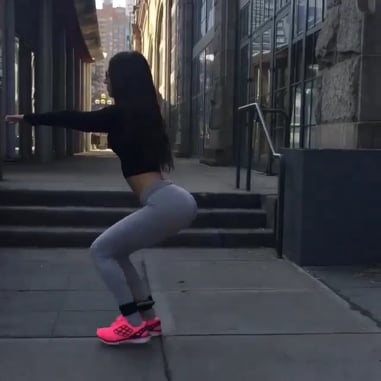
Deep squat with a barbell
This is one of the basic exercises that help to develop this muscle effectively. From the starting position - with your feet apart - lower your pelvis below the knees. Keep your lower back straight and make sure the knees do not go over your feet. Spreading your legs wider apart puts more pressure on your hips.
Romanian deadlifts
Stand up straight with a slight bend at the waist. Holding the dumbbells in both hands, bend over and pull your pelvis backward. Reaching a point just below your knees, return to start.
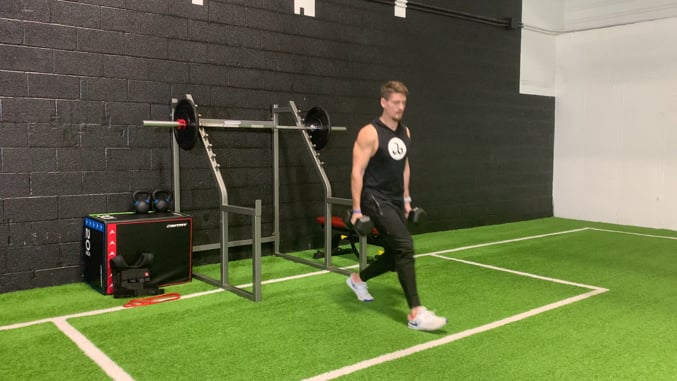
Dumbbell split squat
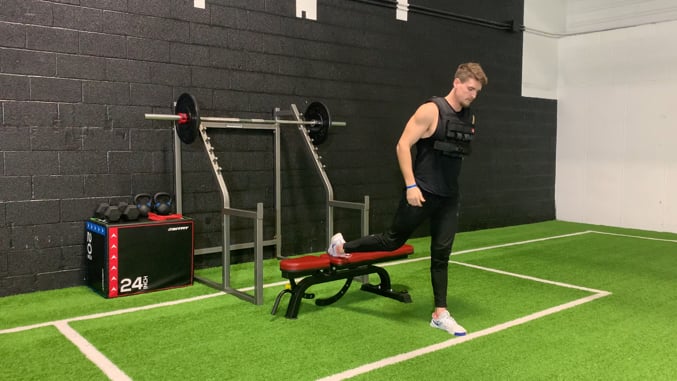
Exercise with a straight back and one leg stepping forward while the other leg is thrown into a brace behind you. Squat down and perform the exercise with both legs.
Back lunges
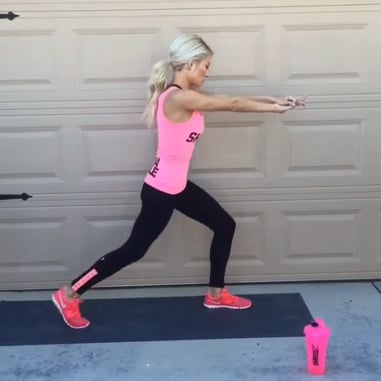
From the standing position, take a large step backward and drop down to form a bent-over position. Return to start and repeat this exercise for the other leg. Make sure your knee is bent at a right angle and not sticking out past your toes, do 20-30 reps. It is important to step backward precisely, maintaining rhythm and balance.
Having great gluteus is everyone's dream, and luckily, developing these muscles isn't difficult if you know the right exercises. So why not take advantage of our tips and start working towards your goal right now?
Read more
Did you know that the deltoid muscle is composed of three parts? Therefore, in order to train more effectively, we need to pay attention to each of them. By doing so, harmonious development of the deltoid muscle is possible. Therefore, the goal is to perform special exercises so that the function of each ligament of the deltoid muscle is involved during training.
If you want to strengthen your deltoid muscles, you need to train them regularly, so we recommend that you do these exercises for the deltoid muscles
Side Dumbbells
If you want to develop the posterior deltoids in your shoulders, this is a great exercise to do. It not only works with the deltoids but also the obliques.Hold the dumbbells with a neutral grip and perform bending forward a little keeping your back straight, at this time the dumbbells should be raised to the level of your ears.
Front Pull-Up
This exercise is great for training the upper body and abdominal obliques.In a seated position, hold a dumbbell in each hand. Lower your arms. Next, raise the dumbbells so that they are parallel to the floor. As you do so, keep your arms straight. When they reach shoulder height, stop. Lower the dumbbells in the same manner. Do the same with the other arm.
Lifting to the Side
Experts recommend performing these exercises to effectively train the outer deltoid muscles. The effectiveness of your training depends on proper practice, so follow these instructions exactly. Hold a dumbbell in each hand and stand up straight. Now slowly lift the dumbbells. When the dumbbells reach shoulder height, hold them there. Then lower the hands slowly and return to the position from the start.
Bench Press
Place the barbell on your chest and bring your elbows forward while tensing your abs, glutes, and legs. Repeat lifting and lowering the barbell, then lifting and lowering again.Do not lift as the bar passes over your face, but lower it toward you for optimal trajectory.If the bar remains in front of you instead of over your body at the apex, you will increase the load on your lower back. Try lifting the bar behind your head. Perform 3-5 sets of 6-8 movements each.
Free Arm Pushups
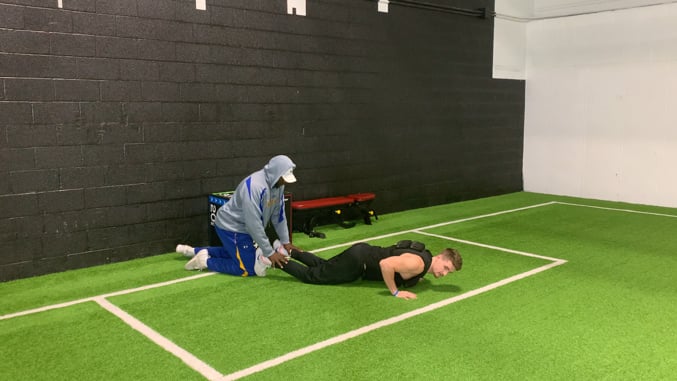
The exercise itself is a repetition of a smaller range of push-ups with the barbell raised.Stand in an inverted position with your feet against the wall. Bend your elbows to lower your body and place your head on the floor. Lower your head backward and repeat. Be careful when lowering your head to the floor (any unintentional movement can injure your neck).Placing a blanket or thick book under your head will make the exercise more effective.To make it more difficult, place some kind of solid support under your arms. The more reps you do in a set, the better. Perform 3-5 sets, depending on your mood.
Developing your deltoid muscles will improve your athleticism and give you a beautiful body, so if you dream of a beautiful body, please do these exercises.
Read more
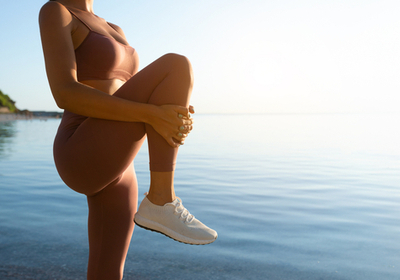
People often underestimate hamstrings. Often, focusing on training the quadriceps and calves, hamstrings seem less important. However, you should remember that neglecting any muscle has aesthetic and medical consequences that can be avoided if you work it properly. The reason you shouldn't ignore these muscles is not just about the symmetry and appearance of your body. Hamstring weakness is one of the most common causes of injury in most professional athletes.
The best way to strengthen your leg muscles is to work them out properly. So let's have a look at the exercises.
Barbell 90
The main advantage of this exercise is that you don't need much equipment, just a simple barbell. Starting in a standing position and holding the barbell on your shoulders, keep your back straight. While bending your knees slightly, tense your hips, and bend forward 90 degrees. Then return to the starting position inhaling. Except for hamstrings, this exercise will also strengthen your hips and back.
Hyperextensions
Hyperextensions are a great workout for your hamstrings as well as the lower back and glute muscles. Sit on the hyperextension training machine comfortably with your heels pressed against the platform at the bottom of the trainer. Place your arms crossed in front of your chest or behind your head. Slowly lower yourself down until you inhale and feel the stretch in your lower back and leg muscles. Without stopping at the bottom point, straighten up to the starting position and exhale. Return to the beginning position then. Maintain your head in line with your torso, keeping your back straight throughout the exercise.
Tights Up
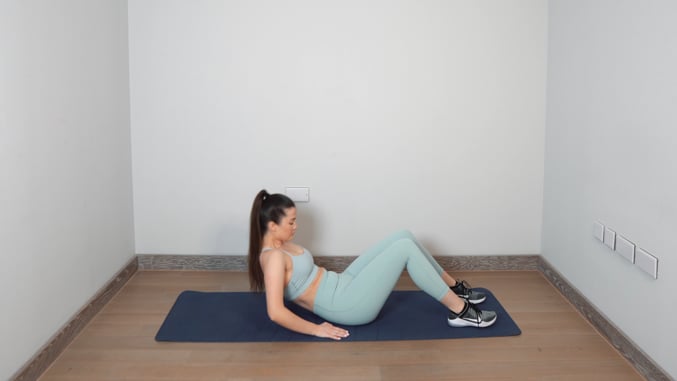
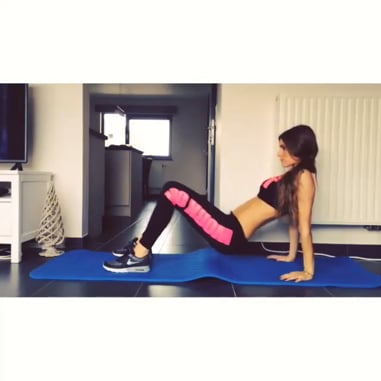
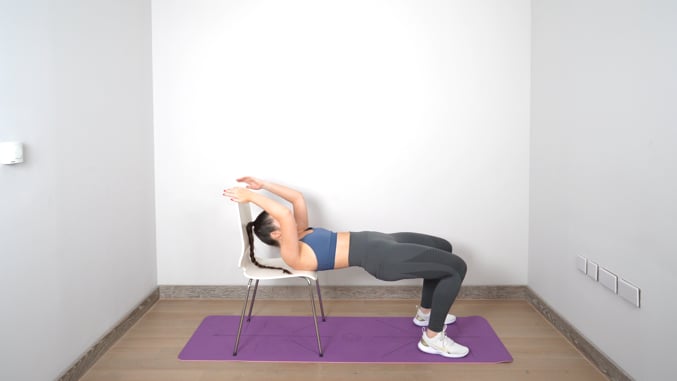
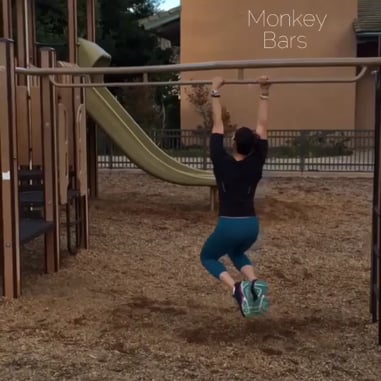
This exercise can be done on the playground with two pull-ups or simply by placing your feet on a chair or bench. We will present a variation of the home exercise.Choose a sitting position on the floor with your feet on a chair. Lift your torso with your hands so that the tights are in the air. Bending your knees, raise the tights so that your body is paralleled to the floor. Perform 7-8 repetitions.
Single-Leg and Dumbbell
The exercise requires a good sense of balance and gives you good results. With a dumbbell in your hand, bring one leg back and keep it on the floor until the end of the exercise. Then return to the previous position. Repeat this exercise several times before you have tired.
Final Words
Hamstrings may look insignificant, but that has nothing to do with the fact that you can skip working these muscles. As a matter of fact, stronger hamstrings prevent you from many injuries. Therefore, don't delay and start exercising these muscles now.
Read more
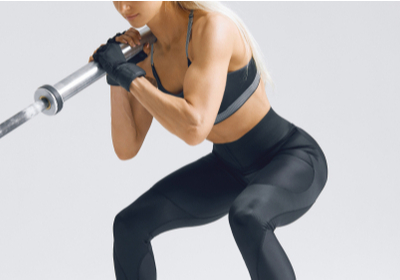
The quadriceps is a large and strong muscle that acts as the primary extensor of the knee joint. Because the knee joint carries most of the body's weight, the quadriceps is the main muscle of the lower thigh. Weakness of this muscle, in fact, would simply make it impossible for people to maintain an upright posture. Quads are made up of the four coronary muscles: the straight, inner, outer, and middle muscles. In spite of this, during various exercises, the load falls completely on this muscle. Sure, strengthening your quads is important, so let's give a quick look at a few of the best exercises for them.
Barbell and Dumbbell Lunging
You can do lunges in many different ways. You can do this either with a barbell, or dumbbells, while walking around the gym, or from a stand-up position. Let's consider a variation where the athlete stands in a position using a barbell or dumbbell. This position is similar to the squat position with a barbell on your back. Take a step forward with your right foot. The lunge should make the thigh of the working leg to be parallel to the ground at the low point. Simultaneously, the knee of the left leg almost touches the floor, also forming a 90-degree angle. Back to the previous position. Change legs - take a step forward with your left leg.
Leg Press
The leg press takes as much of the work out of your back and hips as possible. At the same time, it allows you to train with a much heavier weight than a deep squat. In order to place the load on your quads, your feet should be shoulder-width apart while doing the leg press.
Just follow the right workout technique. Press your back and head firmly against the bench, with your legs almost completely straight and resting on the frame and your hands firmly gripping the handles. Bending the knees, form a straight angle between the thighs and calves. Lower the legs back to the previous position.
Single-Leg Squat
Make single-leg squats if you can't go to the gym to train with training machines. It is a perfect way to get your quads workout done. Because it allows you to load your legs without using extra weight. Start in a standing position, extending one leg slightly forward. While squatting down, extend the leg forward and straighten it. Get back to the previous position. Repeat at least 10 times for each leg.
Kick Squat
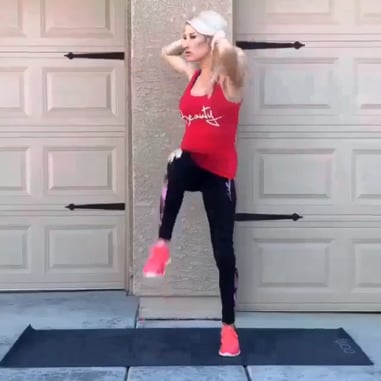
Standing with feet shoulder-width apart and toes slightly to the side, place your hands at your waist or cradle them in front of your chest. Focus on the center of your feet. Squat down horizontally at the hips, remembering to keep your back straight. Stand up shifting your weight to one side. Lift your knee to a horizontal position and make a kick with your foot. The kick should be done in one movement.
Squats With Fitness Ball
Position your feet a little wider than shoulder-width apart with your toes out to the sides at a 45-degree angle. Grasp the fitness ball, keeping a tense and natural bend at the waist, straight shoulders, and neck. Holding the exercise ball, raise your arms up to shoulder height. As you inhale, begin to bend your knees to your sides, making sure they don't stick out past your toes. Your hips should go down first. Your weight is on your heels. Bring your back slightly forward as you squat down and extend your arms to lift the exercise ball over your head. Perform 30-50 repetitions.
Final Thoughts
Every person dreams of having beautiful legs, and luckily, getting great quads isn't that hard if you know what to do. So why don't you try these exercises?
Read more
Many people want to have beautiful thighs. Unfortunately, to keep them in good shape requires long and hard work. Here are some exercises that are sure to help you work out your thighs.
Cross Lunges
This deep stretch will improve your thighs and give you energy. Spread your legs and point your feet outward. Bending your knees, lower yourself into a squat position. Put the palms on your hips above your knees to deepen the squat and stretch further. Jump up and put your feet in front of each other, straightening and crossing your legs as you land. Get back to the position from the start and repeat the actions with the opposite leg. Repeat this exercise as many times as possible, alternating between the two legs, for at least 40 seconds.
Knee Squats
Knee squats together are better to strengthen the inner thighs, quads, and hamstrings than regular squats. And to avoid wasting time, you can work your arms at the same time. Stand up straight with your feet together. Pick up some dumbbells, bend your arms at the elbows, and bring them into contact with your shoulders. Perform squats with your knees bent and your hips pulled back as if you were going to sit on a chair. Keep your feet together throughout the exercise holding the weight on your heels. Now extend your arms upward. Return to the start without transferring the weight to your toes. Do 10 repetitions.
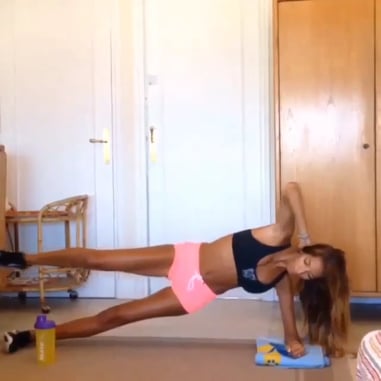
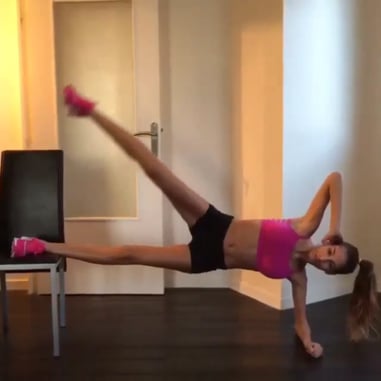
Elbow Plank Leg Lift
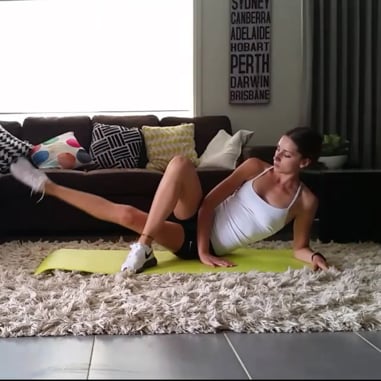
Add leg lifts to the regular elbow plank to improve hip work. Lie on your side, and bend your right arm at the elbow leaning on it. Stretch your leg so that your body is in a straight line. Try to lean only on the outer edge of your right leg. Place your left hand on your hip. Feel your spine stretching and the tension in your abs, then raise your left leg slightly to your hip. Slowly put it back down. Without bending at the waist or leaning on your shoulders, place the weight on your elbows. Do about 15 reps on both sides.
Leg bend swing
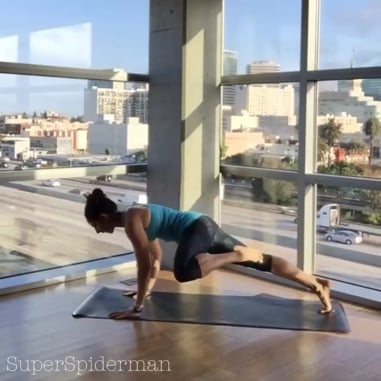
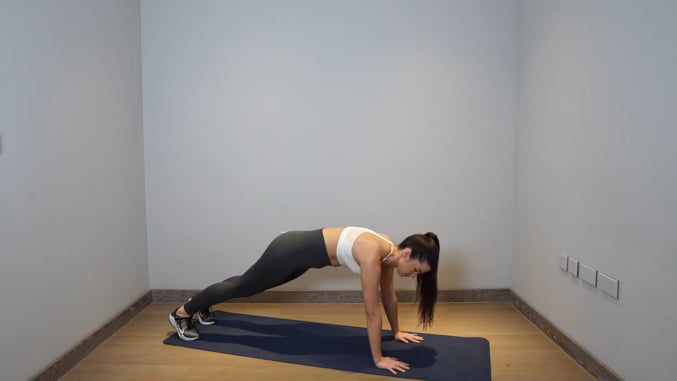
This is one of the most popular exercises for strengthening the hips and thighs. It is suitable for everyone, requires no additional equipment, and does not involve the spine. This combination works the posterior, anterior, lateral, and medial thighs. Start doing the plank with your palms under your shoulders and your knees under your pelvis, keeping your back in position. As you exhale, push up on your heels; do 20 reps on each leg for four sets.
Side push-ups
If this is your first time doing this exercise, you don't need any dumbbells - learn the leg movements first. Holding a dumbbell in your right hand, run hard to the left and place your right hand onto your right leg. Lower your hips as far as you can and lean on your heels. Point your toes forward and bend your leg at a 90-degree angle. Push off with your left foot and get into a courtesy position: left foot back, right foot forward. Raise your arms with weights upward, pointing your feet up. Keep your hips and legs tense. Do not return to the start for the repetitions, but go straight from squat to side position. Perform three sets of 10 reps each, then switch sides.
Final Words
If you know that beautiful thighs are a reality and you have these exercises, then why not try and make your body better?
Read more